
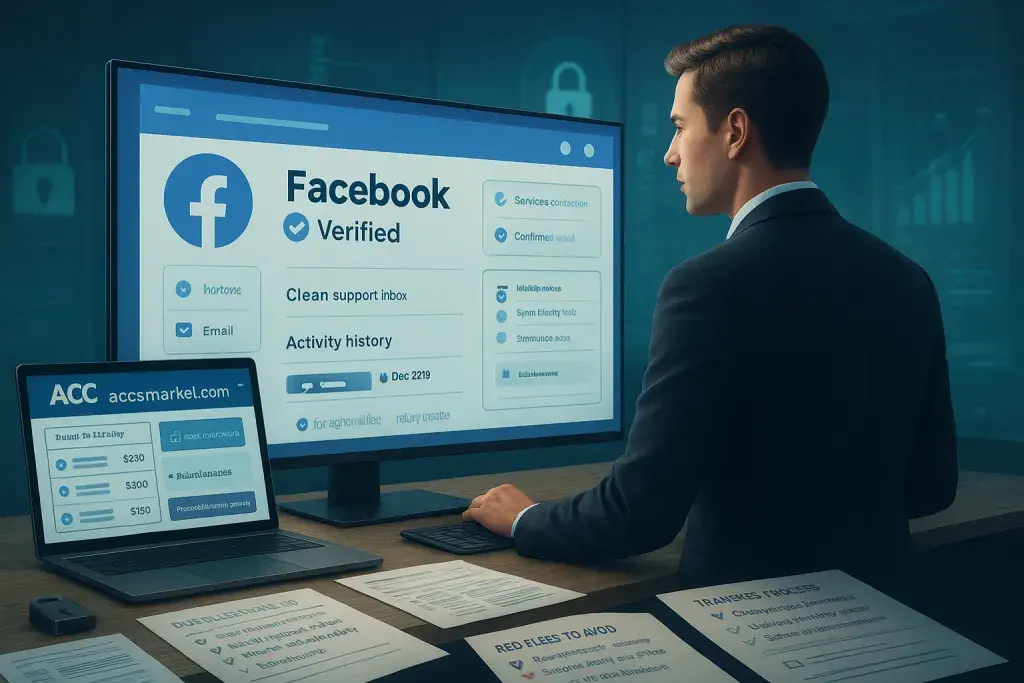
Most people who get burned trying to acquire Facebook accounts make the same mistake: they prioritize price over provenance. A cheap account sourced from an unverified seller is not a bargain - it is a liability. It may be flagged, recycled from banned users, or stripped of the activity history that gives an account its value in the first place. The result is wasted money, lost time, and sometimes a suspended advertising account or business page along with it.
The demand for established Facebook profiles is real and growing. Marketers need accounts with credible history to run campaigns. Businesses require pages with existing audiences. Community managers seek profiles that can operate without triggering the platform's new-account restrictions. The challenge is not finding accounts for sale - it is finding accounts that are genuinely what they claim to be. Platforms that let you buy verified facebook accounts at https://accsmarket.com/en/catalog/facebook represent a more structured approach to this problem, offering documented verification status and account history rather than anonymous listings with no accountability. Understanding how legitimate Facebook account sales work, what verification actually means, and how to evaluate a seller before committing any funds is the foundation of making a safe and effective acquisition.
This guide walks through every stage of that process - from understanding what verified means on Facebook to protecting your investment after purchase.
Understanding What "Verified" Actually Means on Facebook
Platform Verification vs. Account Authenticity
Facebook uses the word "verified" in two distinct ways, and confusing them is one of the most common errors buyers make. The first type is the official blue or gray badge that Facebook grants to public figures, celebrities, and notable brands after a formal review process. This badge signals that the account or page is the authentic presence of a recognized entity. It is tied to identity documentation and cannot be transferred or purchased through any legitimate channel.
The second meaning - and the one relevant to most account acquisitions - refers to whether an account has passed Facebook's internal verification requirements: a confirmed phone number, a verified email address, completed identity fields, and sometimes ID confirmation through the platform's own prompts. When sellers and buyers talk about obtaining verified social media profiles, they typically mean accounts that have cleared these internal checkpoints, not accounts bearing the public badge.
Knowing the difference protects you from sellers who misuse the word "verified" as a marketing term without specifying what was actually confirmed. Always ask a seller to specify which verification elements an account has completed before proceeding.
Why Verification Status Matters for Account Usability
Unverified or partially set-up accounts face immediate limitations on Facebook. They are more likely to hit checkpoints requiring phone confirmation, more susceptible to temporary locks, and less trusted by the platform's automated systems. An account that has been active, confirmed, and used consistently over time accumulates what might be called behavioral credibility - patterns that signal to Facebook's systems that a real person is operating it.
For advertisers, this matters because ad account access, higher spending limits, and access to certain campaign types are all tied to the trust level of the underlying profile. For community managers and page operators, a well-established account avoids the posting and interaction restrictions that Facebook places on newly created or suspicious-looking profiles. In short, verification status is not cosmetic - it directly affects what you can do with the account from day one.
Why People Choose to Acquire Established Facebook Accounts
Business and Marketing Use Cases
The most common reason organizations seek to purchase authenticated Facebook profiles is operational efficiency. Building a Facebook presence from scratch is slow. New accounts face stricter rate limits on friend requests, group invitations, and post visibility. Ad accounts linked to new profiles start with lower trust scores and often require manual review before campaigns go live. An account with months or years of activity behind it simply works better, faster.
Specific use cases include:
- Running paid advertising campaigns without the warm-up period required for new ad accounts
- Managing client pages that require a trusted admin profile
- Operating in Facebook Groups where older accounts face fewer participation restrictions
- Expanding organic reach through profiles with established friend networks
- Testing audience targeting strategies without risking a primary business account
Each of these scenarios has a legitimate operational logic behind it. The key is ensuring that the account acquired actually fits the use case - an account with the right geographic history, language settings, and activity profile for the intended purpose.
Risks of Building From Scratch vs. Acquiring an Established Account
Starting a new Facebook account for business purposes is not inherently wrong, but it comes with friction that is easy to underestimate. Facebook's systems flag accounts that jump immediately into high-volume activity - sending many friend requests, joining multiple groups, or launching ad campaigns - without the gradual behavioral history the platform expects from real users.
Acquiring a genuine Facebook account with an existing history bypasses this friction. However, the comparison is not entirely one-sided. A new account, built carefully over time, carries no prior risk. An acquired account brings its history with it - including any previous warnings, restrictions, or behavioral anomalies. This makes due diligence before purchase not optional but essential.
| Factor | New Account | Acquired Established Account |
|---|---|---|
| Initial trust level with Facebook | Low | Higher, depending on history |
| Ad account readiness | Requires warm-up period | Often immediately operational |
| Risk of inherited restrictions | None | Present if history not verified |
| Time to full functionality | Weeks to months | Immediate if account is clean |
| Cost | Time investment only | Monetary cost required |
How Legitimate Facebook Account Sales Work
What Distinguishes a Legitimate Sale from an Illegitimate One
Legitimate Facebook account sales operate with transparency about what is being sold. A reputable transaction includes clear documentation of the account's verification status, creation date, activity history, and current standing with the platform. The seller can specify whether the account has a confirmed phone number, email, and profile completeness, and can demonstrate that the account has not been flagged, banned, or involved in policy violations.
Illegitimate sales, by contrast, tend to involve bulk-created accounts with synthetic activity, accounts sourced from hacked or compromised users, or misrepresented listings that overstate age or verification status. These accounts pose serious risks: they may be reclaimed by the original owner, suspended by Facebook, or linked to prior violations that surface after purchase.
The distinction often comes down to seller accountability. Legitimate sellers provide account details before payment, offer a defined process for credential transfer, and have a documented track record with verifiable buyer feedback. Anonymous sellers with no history and no recourse mechanism are a consistent warning sign.
The Account Transfer Process Explained
A proper account transfer follows a defined sequence that protects both parties. Understanding this process helps buyers recognize when a seller is cutting corners or creating unnecessary risk.
- The seller provides verifiable details about the account: age, verification elements, activity history, and current status.
- The buyer reviews and confirms that the account matches the stated specifications.
- Payment is made through an agreed method, preferably one that offers transaction protection.
- The seller transfers login credentials, including the primary email and any backup recovery options.
- The buyer updates the account's recovery email and phone number to their own contact details.
- The buyer confirms full access and account functionality before the transaction is considered closed.
Skipping step five - updating recovery information - is one of the most common mistakes buyers make. Until you control the recovery contacts, the previous owner technically retains the ability to reclaim the account through a password reset. This step is non-negotiable.
Pricing Factors in Authentic Account Transactions
Account pricing in legitimate markets reflects real variables, not arbitrary markup. Understanding what drives cost helps buyers assess whether a price is reasonable or suspicious in either direction - too cheap often signals a fraudulent account, while unjustifiably high prices may reflect inflated claims about account value.
Key pricing factors include:
- Account age and the length of consistent activity
- Number and authenticity of friends or followers
- Verification completeness, including phone and email confirmation
- Ad account history and any existing spending limits
- Geographic origin of the account, which affects relevance for regional campaigns
- Presence of associated pages or groups with active audiences
Evaluating Trusted Facebook Verification Services and Sellers
Red Flags That Indicate an Untrustworthy Seller
The market for social media accounts contains a significant number of unreliable or outright fraudulent operators. Recognizing warning signs early prevents costly mistakes. These red flags apply whether you are considering a marketplace platform, an individual seller, or a service that advertises trusted Facebook verification services.
- No verifiable reviews or feedback history from previous buyers
- Refusal to provide account details before payment
- Prices dramatically below market rate without explanation
- Claims of "100% safe" or "guaranteed not banned" with no specifics
- No defined process for credential transfer or post-sale support
- Pressure to complete the transaction quickly with no time for review
- Communication only through unverifiable channels with no paper trail
Any single one of these signals warrants caution. Multiple signals together are a strong indicator to walk away.
What to Look for in a Reputable Account Marketplace
Established marketplaces that facilitate legitimate Facebook account sales share several characteristics that distinguish them from informal or high-risk sources. They operate with documented processes, maintain transaction records, and provide buyers with enough information to make an informed decision before any money changes hands.
Reputable platforms typically offer:
- Categorized listings with specific account attributes clearly stated
- Verified seller profiles with transaction history
- Dispute resolution or buyer protection mechanisms
- Transparent pricing that reflects documented account characteristics
- Customer support accessible before, during, and after a transaction
When evaluating a platform's trustworthiness, look beyond the front page. Examine how the platform handles disputes, what happens if an account is suspended shortly after purchase, and whether sellers are vetted or anonymous. A marketplace that takes seller accountability seriously is fundamentally safer than one that functions as a simple listing board.
Verifying Account Authenticity Before Purchase
Before committing to acquire genuine Facebook accounts from any source, a structured verification process reduces risk substantially. This is not about distrust - it is about due diligence that any careful buyer should expect as standard.
Steps to verify an account before purchase:
- Request a screenshot or screen recording of the account's settings page showing verification status and account creation date.
- Ask the seller to demonstrate active login and account access in real time if possible.
- Check whether the account has any active restrictions by asking the seller to navigate to the account's Support Inbox.
- Confirm that the associated ad account, if included, shows clean billing history and no payment flags.
- Cross-reference the account's stated friend count and page connections with what is shown in the listing.
A seller who refuses any of these steps without explanation is not a seller worth trusting with your money.
Legal and Platform Policy Considerations
Facebook's Terms of Service and Account Transfers
Facebook's terms of service do not permit the sale or transfer of personal accounts between individuals. This is an important fact that anyone considering this market must understand clearly. The platform's position is that accounts represent individual identities, and ownership is not transferable. This means that buying and selling personal Facebook profiles exists in a policy gray area - one where the buyer assumes platform-level risk regardless of how legitimate the transaction itself may be.
Business-oriented assets - such as Facebook Pages, ad accounts associated with a Business Manager, and certain business profiles - operate under different conditions and can be transferred through official platform tools. If your goal is primarily to manage pages or run campaigns, working with these transferable assets through Facebook's own Business Manager infrastructure may be a more sustainable approach than acquiring personal profiles.
Understanding where the policy lines fall does not mean avoiding the market entirely - many professionals operate in it with full awareness of the risks - but it does mean making decisions with clear eyes rather than assumptions.
Managing Legal Risk in Account Transactions
Beyond Facebook's own policies, account transactions exist within the broader legal context of digital asset ownership, fraud, and consumer protection. The risks vary by jurisdiction, but a few principles apply broadly.
First, purchasing an account that was obtained through unauthorized access to another person's profile - even unknowingly - can create legal exposure for the buyer. This is why provenance matters: knowing where an account came from is not just a trust question, it is a legal one.
Second, using an acquired account for activities that violate local laws - spam, coordinated inauthentic behavior, or impersonation - creates liability independent of how the account was obtained. The account's origin does not protect against misuse liability.
Third, keeping a clear record of any transaction, including the account's stated origin, the seller's representations, and the transfer process, provides documentation that can matter if a dispute arises later. Treat account acquisition with the same record-keeping discipline you would apply to any other business transaction.
Best Practices for Securing and Maintaining an Acquired Account
Immediate Steps After Receiving Account Access
The first 24 hours after receiving a transferred account are critical. Acting quickly on a defined checklist reduces the chance of losing access or inheriting problems from the previous owner's settings.
- Change the account password immediately using a strong, unique credential.
- Update the recovery email to an address you control exclusively.
- Replace the linked phone number with your own verified number.
- Review active sessions and log out all devices that were previously authorized.
- Check two-factor authentication settings and reconfigure them under your own control.
- Review the account's current privacy settings and adjust them to match your intended use.
- Examine the Support Inbox for any existing warnings, policy notices, or pending verifications.
Completing this checklist transforms a transferred account from one you technically hold to one you actually control. Each step closes a potential door through which the previous owner or a bad actor could interfere.
Long-Term Account Maintenance to Preserve Trust Status
Obtaining verified social media profiles is only the beginning. Maintaining the account's standing with Facebook requires ongoing behavioral discipline, particularly in the early period after acquisition when the account transitions to new usage patterns.
Practical maintenance principles include:
- Avoid sudden spikes in activity that differ sharply from the account's historical patterns
- Introduce new activities - such as ad campaigns or group management - gradually rather than all at once
- Keep the account's profile information consistent and complete
- Respond promptly to any identity verification prompts Facebook issues
- Avoid tools or browser extensions that automate interactions in ways that violate platform rules
- Use the account from a consistent geographic location where possible, as sudden location changes trigger security reviews
Accounts that are handled carefully after purchase tend to maintain their trust status and functionality over time. Accounts that are immediately pushed into aggressive activity often trigger the exact restrictions that buyers were trying to avoid by choosing an established profile.
What to Do If an Account Is Flagged After Purchase
Even a carefully verified account can encounter issues after transfer. Facebook's automated systems sometimes flag accounts that show sudden changes in login location, device, or behavior - all natural consequences of an ownership change. Knowing how to respond prevents minor flags from becoming permanent suspensions.
If the account is locked pending identity verification, complete the process using whatever documentation the platform requests. If the account was purchased with verification status intact, you should be able to pass these checks using the phone number and email you updated during the handover process. Attempting to circumvent verification prompts almost always results in a more serious restriction.
If the flag appears to relate to a pre-existing policy violation - one that the seller did not disclose - contact the seller immediately and document the issue. A reputable source operating in the space of legitimate Facebook account sales will have a defined process for handling post-sale issues. If the seller is unresponsive or dismissive, escalate through whatever dispute mechanism the marketplace provides, and keep all transaction records accessible.
Questions and Answers
Is it possible to fully verify ownership of a Facebook account after purchasing it?
Yes, but it requires completing specific steps after the transfer. Updating the recovery email, replacing the phone number, reconfiguring two-factor authentication, and logging out all prior sessions collectively transfer control to the new owner. Until these steps are done, the previous owner retains theoretical access through account recovery options.
What account characteristics have the most practical impact on usability for advertising?
Account age, a confirmed phone number, consistent prior activity, and a clean billing history on any linked ad account are the most consequential factors. Facebook's ad systems assign trust levels partly based on how long an account has been active and whether it has a history of compliant behavior - both of which directly affect spending limits and campaign approval speed.
How can I tell if a Facebook account being sold has a history of policy violations?
Ask the seller to provide access to the account's Support Inbox before completing the transaction. This section of the account settings displays any active warnings, policy strikes, or pending reviews. A clean Support Inbox is a basic minimum requirement for any account purchase. Sellers who refuse to show this screen should be treated with serious skepticism.
Are Facebook Pages included in account sales, and can they be transferred separately?
Facebook Pages can be transferred independently of the personal profile that created them, using Facebook's own admin transfer tools within Business Manager. This is actually the safer route for buyers whose primary interest is page management, since it operates within Facebook's official framework rather than requiring a full personal profile transfer.
What is the difference between an account sold by a marketplace and one sold by an individual?
Marketplace transactions generally offer more accountability: documented listings, seller ratings, dispute resolution mechanisms, and defined transfer processes. Individual sales may offer more flexibility in negotiation but provide fewer protections if something goes wrong. For buyers without prior experience in this market, a structured marketplace with verifiable seller histories significantly reduces risk.
How quickly can an acquired account be used for active business operations?
An account with verified status, clean history, and completed ownership transfer can often be put to work within the same day - but gradual onboarding is advisable. Introducing significant new activity patterns slowly over the first week or two gives Facebook's systems time to associate the new behavior with the account without triggering automated security flags.