A business can be profitable on paper and broke in reality. That contradiction confuses more founders and finance teams than any other single concept in accounting. Revenue recognized is not the same as money in the bank, and the gap between the two has closed more companies than outright losses ever did. Understanding how money coming in actually moves through a business - not how it's projected to move, but how it behaves in practice - separates operators who survive lean quarters from those who get blindsided by them.
This is where a structured money-making demo earns its place in financial planning. Rather than treating revenue as an abstract line on a spreadsheet, a well-built demonstration walks through the mechanics: when cash actually lands, what delays it, and how those delays compound. Some of these demonstrations borrow visual logic from unrelated fields - even a money coming demo built for entertainment purposes illustrates the same principle of variable timing and payout rhythm that finance professionals model every day. The comparison is imperfect, but the underlying lesson about unpredictable inflows is not.
What follows is a practical breakdown of how incoming revenue, cash flow demonstration techniques, and financial growth demo models work together to give a clearer, more honest picture of business health.
What "Money Coming In" Really Means in Financial Terms
The phrase sounds simple, but it hides a surprising amount of nuance. Money coming in is not a single event - it's a sequence of steps, each with its own timing risk and each capable of stalling the whole process.
Revenue vs. Cash: The Critical Distinction
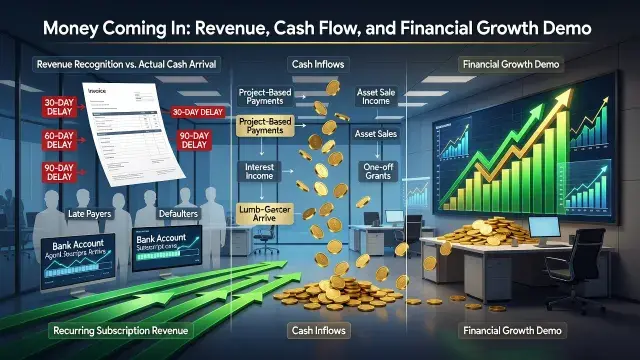
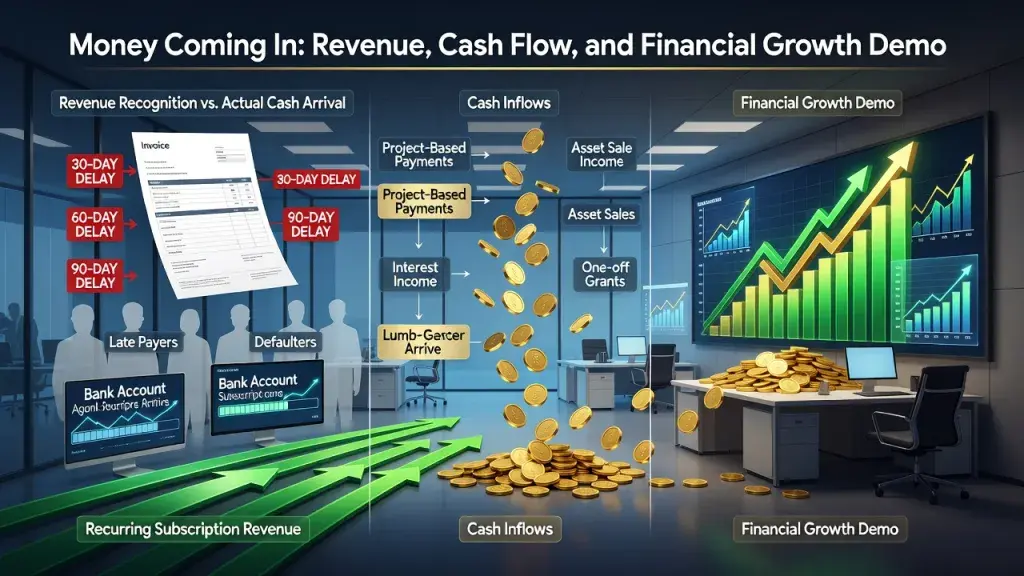
Revenue is recognized when a sale is made or a service is delivered, according to accrual accounting rules. Cash arrives when the customer actually pays. Between those two moments sits an invoice, a payment term, sometimes a dispute, and often a delay. A company can report strong quarterly revenue while its bank balance tells a much tighter story.
The Timing Problem
Payment terms of 30, 60, or 90 days are standard in B2B commerce. Every day a receivable sits unpaid is a day that cash isn't available for payroll, inventory, or debt service. This timing gap is the single most common reason profitable businesses run into liquidity trouble.
Sources of Incoming Revenue
Not all money coming in behaves the same way. Recurring subscription revenue arrives on a predictable schedule. One-time project payments are lumpy and harder to forecast. Interest income, asset sales, and refunds add further variability. A realistic financial model separates these categories rather than lumping them into one generic "revenue" bucket.
- Recurring revenue - predictable, easier to forecast
- Project-based revenue - irregular, tied to milestones
- Passive income - interest, royalties, licensing fees
- One-off inflows - asset sales, tax refunds, grants
Building a Money-Making Demo That Reflects Reality
A demonstration model only has value if it mirrors how money actually moves, not how a founder hopes it will move. The best demos are built on realistic assumptions, stress-tested against worst-case timing, and updated as actual data comes in.
Choosing the Right Assumptions
Every demo starts with assumptions about payment behavior: what percentage of customers pay on time, what percentage pay late, and what percentage default entirely. Pulling these figures from historical accounts receivable data, rather than guessing, is what makes a model trustworthy.
Modeling Best-Case and Worst-Case Scenarios
A single-line forecast is nearly useless. A proper money-making demo runs at least three scenarios - optimistic, expected, and conservative - so decision-makers can see the range of outcomes rather than a false point estimate.
Visualizing the Flow
Numbers on a spreadsheet are hard to internalize. Charts that show cash entering and leaving over time - a rolling 13-week cash view is a common standard - make the pattern visible in a way raw tables don't. This visual approach is also what makes entertainment-style demos, including the money coming demo referenced earlier, effective teaching tools despite their different purpose: they turn abstract probability into something you can watch unfold.
Incoming Revenue: Tracking, Forecasting, and Interpreting Trends
Once a business understands its revenue categories, the next challenge is tracking them accurately and forecasting forward with discipline rather than optimism.
Setting Up Reliable Tracking Systems
Manual tracking in spreadsheets works for very small operations, but it breaks down fast. Accounting software that integrates invoicing, banking, and receivables into one dashboard removes the lag between when money arrives and when the business knows about it.
Forecasting Methods That Actually Hold Up
Simple trailing-average forecasts work reasonably well for stable, recurring revenue. Seasonal businesses need a model that accounts for cyclical swings rather than a flat average. Weighted forecasting - giving more weight to recent months - tends to outperform naive historical averages when the business is growing or contracting quickly.
Reading Trends Correctly
A spike in incoming revenue isn't automatically good news if it's driven by a single large client who could leave next quarter. Concentration risk matters as much as the total figure. Diversification across customers and revenue streams reduces the odds that one lost contract disrupts the entire inflow picture.
Cash Flow Demonstration: Making the Invisible Visible
Cash flow is often the least understood financial statement, partly because it's the one most disconnected from intuition. A clear cash flow demonstration fixes that by making the timing of money explicit rather than implied.
Operating, Investing, and Financing Flows
Cash moves through three distinct channels: operations (day-to-day business activity), investing (asset purchases or sales), and financing (loans, equity, dividends). Separating these clarifies whether a cash increase came from healthy sales growth or from taking on new debt - two very different signals.
The 13-Week Cash Flow Model
Short-term cash flow demonstration models, typically spanning thirteen weeks, are the standard tool for spotting liquidity crunches before they happen. They force weekly granularity instead of monthly averages, which is exactly the resolution needed to catch a payroll gap two weeks out.
Common Mistakes in Cash Flow Projections
Overestimating collection speed is the most frequent error. Founders assume invoices get paid on the stated terms; in practice, actual collection periods often run longer. Ignoring seasonal dips, double-counting revenue that's already been collected, and failing to build in a cash buffer round out the list of recurring mistakes.
- Assuming 100% on-time payment from customers
- Failing to separate one-time inflows from recurring ones
- Omitting tax obligations from the projection
- Not stress-testing for a delayed major payment
Financial Growth Demo: Connecting Cash Flow to Long-Term Strategy
Short-term liquidity keeps the lights on, but a financial growth demo answers a different question: is the business getting structurally stronger over time, or just staying afloat?
Growth Metrics That Matter Beyond Revenue
Revenue growth alone can mask deteriorating margins or rising customer acquisition costs. A meaningful growth demo pairs top-line figures with gross margin trends, customer lifetime value, and churn rate to give a fuller picture of whether growth is sustainable or borrowed against future problems.
Reinvestment vs. Distribution
Every dollar of incoming revenue faces a choice: reinvest into growth or distribute to owners and shareholders. A financial growth demo should model both paths and show the compounding effect of reinvestment over multiple years - the difference is often larger than intuition suggests.
Stress-Testing Growth Assumptions
Aggressive growth projections deserve skepticism. A responsible demo tests what happens if growth rates come in at half the projected pace, or if a key cost - like customer acquisition - rises unexpectedly. Businesses that plan only for the best case are the ones least prepared when reality falls short of it.
Turning Demonstrations Into Decisions
A demo, however well built, is only useful if it changes behavior. The final step is translating the model's output into concrete financial decisions.
Setting Cash Reserve Thresholds
Based on the cash flow demonstration, businesses can set a minimum reserve - often expressed as weeks or months of operating expenses - that triggers action when balances fall below it, whether that means cutting spending, accelerating collections, or drawing on a credit line.
Adjusting Payment Terms and Collection Practices
If forecasting reveals that late payments are the dominant risk to incoming revenue, tightening payment terms, offering early-payment discounts, or automating collections follow-up are direct, actionable responses rather than abstract fixes.
Revisiting the Model Regularly
A demo built once and never updated becomes misleading within a quarter. Markets shift, customer behavior changes, and cost structures evolve. Rebuilding the model on a rolling basis - monthly for cash flow, quarterly for growth projections - keeps the numbers honest.
Frequently Asked Questions
Why does a profitable business sometimes run out of cash?
Profit is an accounting figure based on recognized revenue and matched expenses, while cash reflects actual money in the bank. A company can have strong sales on credit terms but still face a shortfall if customers pay slowly and expenses like payroll and rent are due immediately.
How often should a business update its cash flow demonstration?
Weekly updates work best for short-term models like the 13-week cash flow view, since they catch timing issues before they become emergencies. Monthly reviews are usually sufficient once the business has stable, predictable payment patterns.
What's the difference between a cash flow demonstration and a financial growth demo?
A cash flow demonstration focuses on near-term liquidity - whether there's enough cash to cover obligations in the coming weeks or months. A financial growth demo takes a longer view, evaluating whether the business's revenue, margins, and customer base are expanding in a sustainable way over years.
What's the biggest mistake companies make when forecasting incoming revenue?
Assuming customers will pay exactly on the stated terms. Real-world collection periods almost always run longer than contractual terms suggest, and failing to account for that gap is the most common cause of inaccurate cash forecasts.
Can small businesses build these models without expensive software?
Yes. A spreadsheet with clearly separated categories for recurring revenue, one-time inflows, and expenses can serve as a functional starting model. Dedicated accounting software becomes more valuable as transaction volume grows and manual tracking becomes error-prone.
How do you know if revenue growth is actually sustainable?
Check whether margins are holding steady or shrinking as revenue increases, and look at customer concentration - growth driven by a handful of large accounts is riskier than growth spread across a broad customer base. Sustainable growth typically shows stable or improving unit economics alongside rising revenue.